Backend — Functionality
What the Genesis API actually does, feature by feature. All endpoints return
the standard { success, data, message } envelope and (except auth) require
a valid JWT access token.
Accounts & authentication
- Sign-up with email and password; passwords are stored hashed.
- Login issues a short-lived access token and a longer-lived refresh token; refreshing rotates the refresh token so a stolen one is only usable once.
- Logout invalidates the session server-side.
Workspaces
A workspace is the unit of collaboration. Each workspace:
- has a fixed annotation type chosen at creation —
COREF,NER,POS, orWSD— which determines the editor the frontend renders and the annotation endpoints that apply; - has an owner and members with roles that gate who can manage members, upload documents, and annotate;
- contains any number of documents.
Documents & tokenization
- Documents are uploaded as plain text (TXT) or pre-annotated CoNLL-2012.
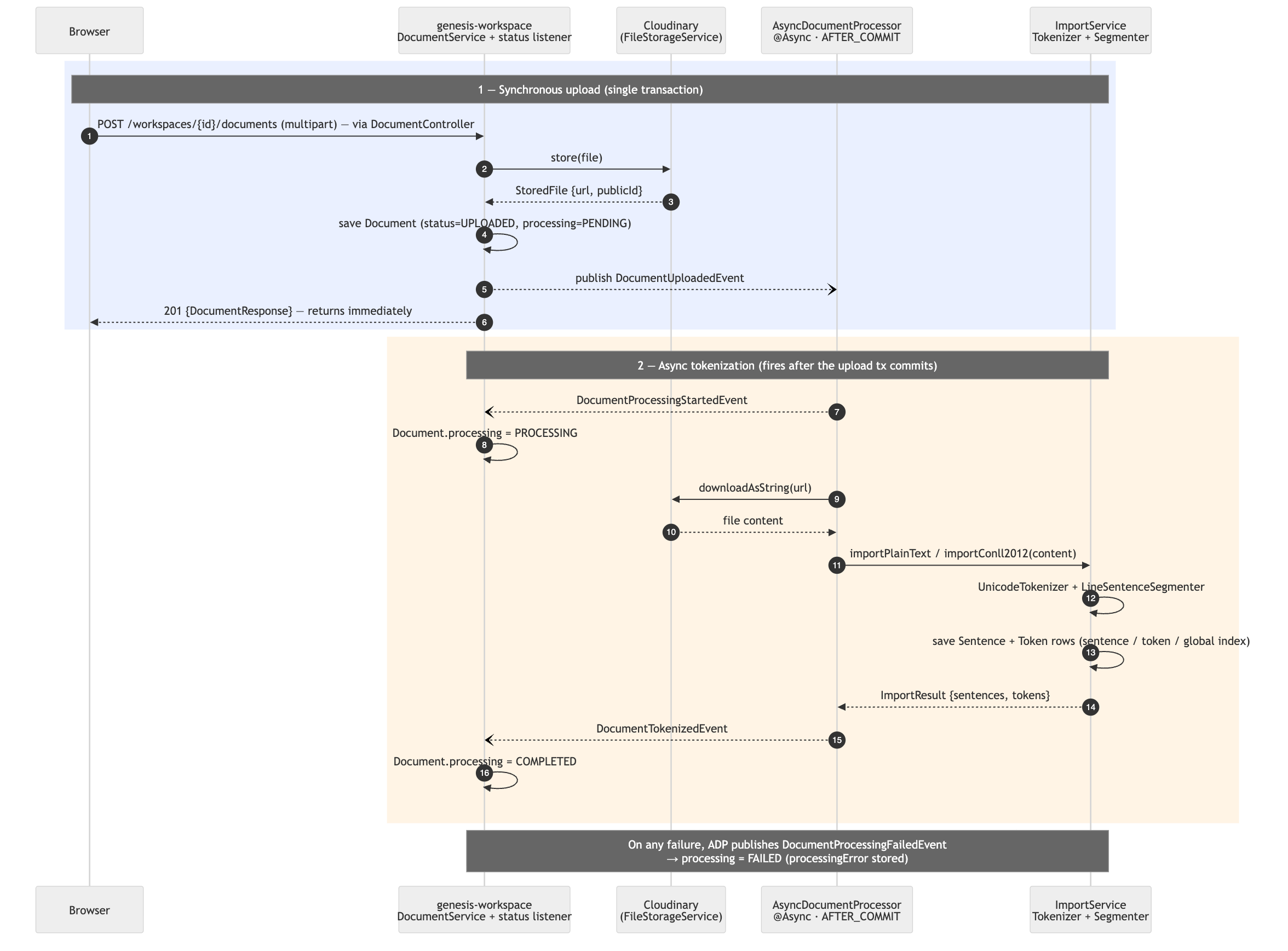
- On upload, the backend stores the raw file, then tokenises the content into sentences and tokens (with global and per-sentence indices) so that annotations can reference exact token spans.
- Large documents are served to the editor in pages (keyset pagination) so the UI can lazy-load instead of fetching the whole corpus at once.
What happens between "user picks a file" and "document ready to annotate":
Annotation
Each annotation type has its own module and endpoints, all operating on token spans:
- Coreference — create mentions over token ranges, group mentions into clusters, merge clusters, delete mentions/clusters.
- NER — label token spans with entity types.
- POS — assign part-of-speech tags per token; supports custom tag sets per workspace and CSV import of tags.
- WSD — maintain sense inventories and assign senses to ambiguous tokens.
Annotations are per-user where the workflow requires comparing annotators (disagreement views), with editor sessions persisted server-side so an annotator can resume exactly where they stopped.
Recommendations
A rule-based recommender suggests likely annotations (e.g. candidate mentions) which annotators can accept or dismiss; dismissals are remembered per user.
Notifications
Cross-module events (document uploaded and tokenized, member added, etc.) generate in-app notifications for the affected users, delivered through a polling endpoint and shown by the frontend's notification dropdown.
Import / export
- Import: TXT (tokenised on upload) and CoNLL-2012 (tokens + existing annotations preserved).
- Export: workspace or document annotations as CoNLL-2012 and CSV (POS), suitable for downstream NLP pipelines.
Health & observability
/actuator/healthaggregates per-module health indicators plus the database connection.- Prometheus-format metrics at
/actuator/prometheusin prod. - Structured request logging with a rolling file in prod.