Genesis Handbook
Genesis is a collaborative platform for linguistic annotation. Teams create workspaces, upload text corpora, and annotate them for coreference resolution, named-entity recognition (NER), part-of-speech (POS) tagging, and word-sense disambiguation (WSD) — then export the results in standard formats such as CoNLL-2012.
The simplest way to picture the system — users, the web app, the API, and the data they exchange:
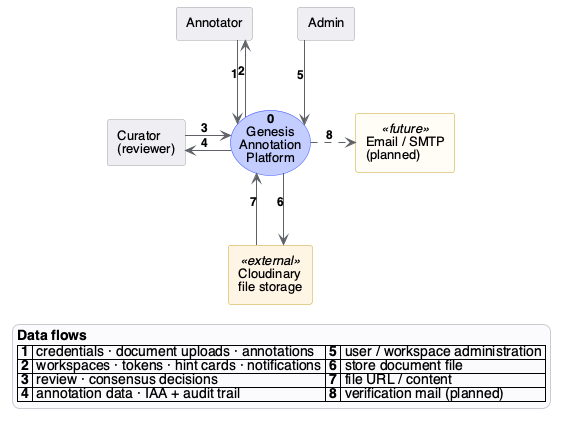
The platform is built as two applications plus a database:
| Component | Technology | Role |
|---|---|---|
| Backend | Spring Boot 3 (Java 21), modular monolith | REST API, auth, annotation logic, persistence |
| Frontend | Next.js 15 (TypeScript) | Web UI: workspaces, document management, annotation editors |
| Database | PostgreSQL 16 | All persistent state |
How this handbook is organised
- User Guide — how to use Genesis, screen by screen, written for annotators with no technical background.
- Repositories — the three Git repos, what each one owns, branching rules, and the license.
- Backend — Architecture explains how the backend is built (modules, layers, events, auth); Functionality explains what it does (features and flows).
- Frontend — Architecture covers the Next.js application structure; Functionality covers the user-facing behaviour.
- Deployment — Setup takes a fresh machine to a running stack; Operations covers day-2 tasks: logs, updates, backups, rollback.
Deployment model in one paragraph
Both application repositories carry a long-lived uni-prod branch that
represents exactly what runs in production. A separate deployment repository
(genesis-deploy, where these docs live) fetches both repos at that branch,
builds each app with the Dockerfile maintained in its own repo, and starts
the full stack — PostgreSQL, backend, frontend — with a single
docker compose invocation wrapped in ./scripts/deploy.sh. The same
scripts run in CI on every change, so a green pipeline means the deployment
works end-to-end.